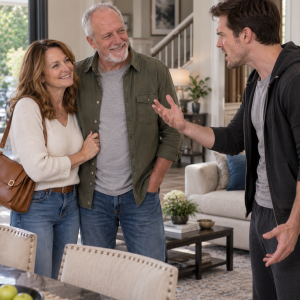
Scott looked at me.
“Meredith, tell them this has gone far enough.”
I almost felt sorry for him.
Almost.
“I’m not doing anything,” I said. “That’s what frightens you, isn’t it? For once, I’m not cleaning up your mess.”
The Woman I Cried For
When I finally left the Hawthorne estate, my legs were trembling so badly that I had to grip the steering wheel before starting the car.
I did not drive.
Not immediately.
I sat in the dark while the garden lights glowed behind me and cried for the first time in twenty-one days.
Not for Scott.
Not for Vanessa.
Not for the house we had shared or the marriage that was now becoming a stack of legal documents.
I cried for the woman I had been.
The woman who asked reasonable questions and apologized for asking them.
The woman who kept special dresses for dinners her husband arrived late to.
The woman who believed being easy to live with meant having fewer needs.
The woman who accepted crumbs of tenderness and called them proof that everything would eventually improve.
Three months later, I left our large home in a gated neighborhood north of Charlotte. I did not fight over the imported furniture or the expensive lighting fixtures Scott had treated like symbols of success.
I took my books.
My parents’ photographs.
A blue ceramic dinner set I had owned before marriage.
And the old coffee maker Scott disliked because he said it made the kitchen look cheap.
I rented a small second-floor apartment in Davidson, above a bakery that started work before sunrise. There was a crack near the living-room window, the bedroom closet was too small, and the kitchen could barely hold two people.
But nobody lied to me there.
Nobody arrived at one in the morning with invented meetings.
Nobody made me feel unreasonable for noticing what was directly in front of me.
I returned to work at the county archive and eventually began leading public workshops on family records, local history, and financial document preservation.
One afternoon, after a workshop, a woman in her early sixties remained behind.
She held a folder against her chest.
“Do you think someone can start over when they’ve already given away most of their life?”
I looked at her for a long moment.
I knew immediately that she was not asking about genealogy.
“Yes,” I said. “But sometimes the first step is admitting that familiar isn’t the same thing as safe.”
She lowered her eyes.
I understood.
So did she.
What Came After the Party

Over the following months, the inquiry expanded.
Several Hawthorne facilities were audited. Business arrangements were reviewed. Accounts were restricted while investigators traced the movement of funds. Martin Cole cooperated fully, and other employees eventually began providing records of their own.
Scott sent me message after message.
First angry ones.
Then defensive ones.
Then sentimental ones.
One morning, just before dawn, I received a final plea.
“Meredith, nobody knows me like you do. I made mistakes. Vanessa meant nothing. Please help me.”
I read it at my little kitchen table with coffee warming my hands.
For a few seconds, I remembered the younger Scott, the man who once drove me two hours to see a meteor shower because I had mentioned, casually, that I had never seen one. I remembered the book he gave me on our second anniversary with an awkward handwritten note inside. I remembered the man who held me through a season when I believed my heart would never feel steady again.
Then I remembered everything else.
I deleted the message.
I blocked his number, not because I wanted revenge, but because peace sometimes requires a locked door.
Several weeks later, I found Vanessa waiting outside the archive building.
She wore jeans, a plain gray sweater, and no visible jewelry. She looked older than she had at the party.
“I’m not here to ask you to forgive me,” she said. “I don’t want to apologize just so I can feel like a better person.”
I said nothing.
“I cooperated with the investigators. I turned over messages from my father. And from Scott.”
She swallowed.
“I didn’t do it for you. At least, I don’t think I did. I just couldn’t keep carrying a lie that had damaged my life too.”
I nodded.
“That doesn’t erase what you chose.”
“I know.”
For the first time, I saw no arrogance in her.
Only consequence.
And consequence, I had learned, can teach lessons pride refuses to hear.
“Take care of yourself, Vanessa.”
Her eyes filled.
I crossed the street.
There was no embrace. No friendship. No neat ending in which two women joined hands and pretended betrayal had somehow made them sisters.
Real life is rarely that tidy.
Sometimes healing means each person carries what belongs to them and stops placing it in someone else’s arms.
The Life That Was Finally Mine
About six months after the garden party, a statewide women’s professional association invited me to speak at a small community forum about financial manipulation inside long-term relationships.
My first instinct was to decline.
Part of me still heard Scott’s voice insisting I exaggerated, that respectable people kept private matters private, that nobody would believe a quiet archivist over successful businessmen with expensive attorneys.
But I accepted.
The audience was not large.
There were teachers, nurses, small-business owners, office managers, retirees, college students, and women who had spent years managing homes without ever seeing the complete financial picture of their own marriages.
I did not tell the story for entertainment.
I did not mention the lace garment, the dropped champagne glass, or the expensive garden party.
I spoke about the smaller things.
How control often begins quietly.
How one person handles every account and calls it convenience.
How questions become accusations.
How secrecy gets renamed privacy.
How capable people can slowly be persuaded that they are helpless.
When I finished, a woman with silver hair approached me and took both my hands.
“I thought at my age it was too late to stand up for myself.”
I squeezed her fingers gently.
“It isn’t too late while the life is still yours.”
That evening, I walked home slowly.
The bakery downstairs was closing. A dog barked from a nearby porch. Someone laughed across the street. A delivery truck rattled through the intersection.
I stopped outside my building and looked up at the warm light in my apartment window.
It was not a mansion.
There were no perfect hedges.
No valet parking.
No garden full of people pretending everything was beautiful.
It was small.
Imperfect.
Mine.
What Scott had done cost me a marriage, a home, and the comfortable illusion that endurance was the same thing as love.
But somewhere inside that loss, I found my own voice again.
And I finally understood something I wish I had known years earlier: when someone humiliates you because they believe you are too weak to walk away, they may not be ending your story at all.
They may simply be waking the person who was quiet for far too long.