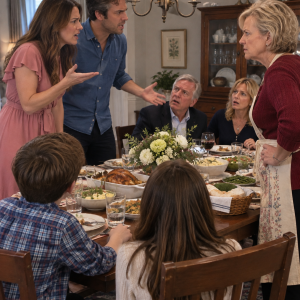
PART 1 — THE CHAIR AT CHRISTMAS DINNER
“THE CHAIR HURTS.”
“If you tell anyone those stories about your father again, Sophia, somebody might decide you can’t stay with us anymore. Is that what you want?”
I heard my sister-in-law, Elisa, say those words before I even reached the dining room.
Her voice was low, but the warning was unmistakable. A moment later, my five-year-old niece appeared in the hallway, clutching a stuffed rabbit with one ear bent backward.
When she saw me, she stopped.
“Uncle Michael?”
“Hey, little bird.”
She usually ran into my arms. That evening, she only looked toward the dining room, as though she needed permission to smile.
Behind her, Elisa appeared carrying a stack of folded napkins.
“Michael! We didn’t hear you come in.”
She leaned over to kiss my cheek, then placed a hand on Sophia’s shoulder.
“Go sit down, honey. Dinner’s ready.”
Sophia didn’t move.
I watched her fingers tighten around the rabbit.
Something about that moment stayed with me, especially when I later noticed the small black object attached beneath her dining chair.
I had driven from Chicago to spend Christmas with my younger brother, Marcus, and his family in Lake Forest, Illinois. We hadn’t been together in eight months, and I had hoped the holiday might give us a chance to reconnect.
Marcus ran a successful cybersecurity consulting firm. His clients included financial institutions and large corporations, and he liked reminding people that his work involved information most people weren’t trusted to see.
I made investigative documentaries, usually about financial misconduct and people who suffered when powerful organizations protected themselves.
Marcus called my work glorified troublemaking.
I called his work profitable.
We loved each other, but we hadn’t understood each other in years.
His house looked spectacular that evening. White lights framed the windows, a Christmas tree towered beside the staircase, and an enormous mahogany dining table was set with crystal glasses and polished silverware.
Yet Sophia stood beside her chair with the expression of someone facing a punishment.
“Sit down, sweetheart,” Elisa said.
Sophia shook her head.
“The chair hurts.”
Marcus looked up from carving the prime rib.
“Sophia, we’ve talked about this. Sit down.”
“But Daddy—”
“Enough. We have a guest.”
Sophia lowered herself carefully onto the wooden seat. Her shoulders tightened, and tears filled her eyes almost immediately.
I put down my fork.
“Marcus, what’s wrong with her?”
“Nothing. She’s been doing this for days.”
“She looks like she’s in pain.”
Elisa gave an embarrassed laugh.
“She’s discovered that making a fuss gets everyone’s attention.”
Sophia stared at her plate.
“It really hurts,” she whispered.
Marcus set down the carving knife.
“Michael, don’t encourage this. She’s our daughter, and we know when she’s pretending.”
I studied Sophia’s face.
I had spent years interviewing people who were frightened to speak openly. Children were different from adults, of course, and I knew better than to assume I could read anyone’s mind.
But I couldn’t ignore a little girl who was visibly struggling to sit.
“How about we find you a cushion?” I asked.
Sophia glanced at Marcus before answering.
“I’m okay.”
She wasn’t.
The Thing Beneath the Seat
Dinner continued, although I barely tasted anything.
Marcus talked about a new office lease downtown, and Elisa described the Christmas party she’d organized for his employees. Sophia ate a few bites of potato while holding her rabbit in her lap.
Whenever she shifted in her chair, she winced.
After dessert, Marcus went into the kitchen to take a business call. Elisa began clearing plates.
Sophia approached me near the doorway.
“Uncle Michael?”
“What’s up, little bird?”
She glanced behind her.
“Can I show you something?”
“Of course.”
She took my hand and led me back to the dining room. Then she pointed underneath her chair.
I crouched.
Attached to the underside of the wooden seat was a small black plastic case, held in place with dark adhesive. One corner protruded slightly below the seat frame, where it could catch against someone’s leg when the chair shifted.
I didn’t recognize the device.
“Did you find this?” I asked.
Sophia nodded.
“Daddy said I wasn’t supposed to touch it.”
“Does he know it’s bothering you?”
Her eyes filled.
“I told him.”
“What did he say?”
She looked toward the kitchen.
“He got mad.”
I stood and pulled the chair back from the table.
“You don’t have to sit there anymore.”
Sophia stared at me as though I’d suggested something impossible.
“But that’s my chair.”
“Then tonight you can sit somewhere else.”
I moved another chair beside mine.
She didn’t sit down. Instead, she tugged at my sleeve.
“Would you believe me if I told you something?”
“I’ll listen.”
She held out her arm.
Dark marks showed above her wrist, partly hidden by the sleeve of her red velvet dress. When she lifted the fabric near her knee, I saw other bruises, some darker than others.
I felt a cold heaviness in my stomach.
“Sophia, did someone hurt you?”
She nodded.
I kept my voice steady.
“You aren’t in trouble. You can tell me what happened.”
Her words came slowly. She told me that Marcus sometimes came into her room after bedtime, that he made her participate in what he called a secret game, and that she was frightened when he became angry.
I did not ask her to demonstrate anything or explain details she wasn’t ready to share.
When I asked whether she’d told her mother, Sophia nodded again.
“Mommy said I was making things up.”
“What happened after that?”
“She said people take bad kids away.”
Her lower lip trembled.
“Uncle Michael, are you going to tell Daddy?”
I knelt beside her.
“I’m going to get you help. You haven’t done anything wrong.”
She began crying quietly.
“Promise?”
“I promise I’ll do everything I can to keep you safe.”
Elisa called from the kitchen.
“Sophia? Where are you?”
Sophia stiffened.
I stood.
“She’s with me. We’re getting some water.”
Elisa appeared a moment later.
“What are you two whispering about?”
“Sophia isn’t feeling well,” I said. “I think she needs to see a doctor.”
Elisa’s smile disappeared.
“Michael, she’s fine.”
“She’s having trouble sitting, and she has bruises.”
“She fell at the playground last week. We’ve already dealt with it.”
“I’d feel better if someone checked her.”
Elisa crossed her arms.
“You’re not her parent.”
“No,” I said. “But I’m her uncle, and I’m concerned.”
Marcus returned from the kitchen.
“What’s going on?”
“Your brother thinks Sophia needs a doctor,” Elisa said.
Marcus looked at me.
“For a few bruises?”
“For pain that hasn’t gone away.”
His expression hardened.
“Michael, you’re here for Christmas dinner. Don’t turn this into one of your investigations.”
I looked at Sophia, who had moved behind her mother.
I knew a confrontation in that dining room would not help her. I also knew I couldn’t simply leave and hope things improved.
“All right,” I said. “I’m not going to argue.”
Marcus relaxed slightly.
But when I stepped into the hallway, I took out my phone.
The Call I Couldn’t Put Off
I contacted an urgent medical advice service and explained what I’d observed. I described Sophia’s pain, the bruising, and the statements she’d made without trying to interpret them.
The clinician I spoke with told me the situation required prompt medical assessment and that a child protection team might need to become involved.
“Please don’t question her repeatedly,” the clinician said. “Let trained professionals speak with her. If she’s in immediate danger, contact emergency services.”
I thanked her and ended the call.
For a few seconds, I stood beside the Christmas tree, listening to Marcus laugh at something on television.
I remembered Sophia asking whether I believed her.
Then I called the local authorities to report my concerns and ask for immediate help getting her assessed safely.
I explained that I was an uncle visiting from out of town, that the parents were dismissing the child’s complaints, and that I feared she might not be safe if I left.
The dispatcher kept me on the line while arranging a response.
I returned to the dining room and sat beside Sophia.
“Would you like me to read you a story?” I asked.
She nodded.
I found a children’s book on the shelf near the fireplace. As I read, she leaned against my arm, holding her rabbit between us.
Marcus looked over.