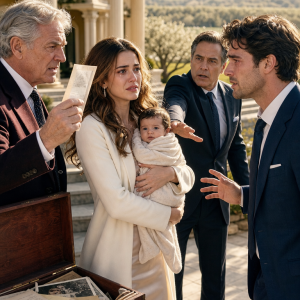
“That’s her,” he breathed.
“Don’t look at her as if you have been waiting,” I said. “You left.”
Evan admitted knowing who I was from the day of the conference. He had feared I would see his father whenever I looked at him. I reminded him that I had confided in him about the powerful stranger who ruined my mother’s career while he quietly knew the man’s name.
Then he explained the night he disappeared. After learning about the pregnancy, he confronted Richard and demanded the entire story. Richard offered him a bargain: if Evan stayed away from me until the baby arrived, control of his grandmother’s trust—nearly three million dollars—would finally be transferred to him.
“I accepted,” Evan said.
“You traded my pregnancy for access to your money.”
“I told myself I was securing our future. Once the trust was mine, he could never control where we lived or how we raised our child.”
“You planned my future without me,” I said. “I attended every appointment alone. I watched Hazel struggle through those first twelve days, and you were nowhere because you had decided your secret plan mattered more than my right to choose.”
Richard remarked that the arrangement had ended when she arrived. I asked why Evan had not returned immediately. He reached inside his coat and handed me a thick envelope. The trust had transferred three days earlier, and since then he had been collecting documents he believed would prove what Richard had done to my mother.
One page claimed that Laura Morgan had voluntarily accepted compensation and surrendered any future complaint. My mother’s signature appeared at the bottom, but the payment had never reached her. Banking records showed it had been routed into a holding company controlled by Richard.
“The signature was copied,” Evan said. “My grandfather ordered that money given to your mother after he learned how she had been treated. My father kept it and used her name to make the records look legitimate.”
Richard stepped forward, but Evan placed himself between us.
“It ends today,” he said. “You do not get to own the truth anymore.”
What Protection Had Cost Us
Walter had heard enough. He faced Richard with a quiet anger more powerful than shouting and described the years my mother had spent cleaning offices at night after selling her car, believing she had become unemployable because she had done something wrong.
Richard answered that he had been protecting his reputation.
That sentence revealed the center of everything. My mother had hidden the past to protect me. Walter had honored her silence for the same reason. Evan believed money would protect our future. Richard protected his name by taking away another person’s livelihood and dignity. Each had used the same noble word while deciding what someone else could know.
Evan understood it too.
“I convinced myself I was sacrificing a few months for Claire and the baby,” he said. “But I repeated your mistake. I made a decision for a woman because I assumed I knew what was best for her.”
He did not ask me to forgive him. When he asked to meet Hazel, I let him come close but kept her in my arms.
“You may become the father she deserves,” I told him. “That does not mean you and I are together.”
He nodded, though the disappointment was visible.
“I understand.”
“No secret arrangements. No disappearing to solve things alone. Decisions about Hazel are discussed and agreed upon. If you are frightened, you say so. If your father applies pressure, you tell me. Do not promise me you will never leave. Show me, one ordinary day at a time, that you know how to stay.”
The documents went to an attorney. After so many years, the path forward was complicated, but the copied signature and transfers were enough to begin a civil case and force a review of several accounts. Richard lost his hold over the family story, which may have mattered to him more than the money.
Evan left the estate, declined a position in the family company, and rented an apartment near Middlebury. Then he began doing the most necessary thing: he showed up.
If Hazel had an appointment at nine, he arrived at eight forty-five. If she needed diapers, he went himself. When he did not understand something, he asked. It once took him six attempts to secure the infant carrier, and when the buckle clicked, he grinned like a man atop a mountain.
Walter remained cautious. One afternoon, however, he admitted that his own silence had also been unfair.
“Your mother asked me to keep the past from you,” he said, “and I thought honoring her meant honoring that request forever. But you grew up. The truth became yours, and I should have given it to you.”
The Choice to Stay

Months later, I found one final letter in the cedar trunk. My mother had written it to Walter. She said Evan had been a kind boy and should never be measured by his father’s conduct. Near the end, she added that she wanted me to know I could walk away from any place where I was not respected, even when I loved someone inside it.
That evening, Evan returned Hazel at exactly six. She slept against his chest, one fist curled into his sweater.
“She ate at four twenty, and I changed her just before five,” he reported. “She only cried when I sang.”
“She has excellent judgment.”
He smiled, then grew serious.
“I want you back, Claire. I will not pretend otherwise. But I need you to know that even if you never choose me again, I will still be here for Hazel.”
Once, I might have heard romance. Now I heard something sturdier: responsibility without reward.
Trust returned in small portions—a promised call, an uncomfortable fact offered before I asked, an honest “I don’t know” where a comforting lie might once have been. Walter eventually allowed Evan into his workshop, first because Hazel liked the brass pendulums and later because he recognized the grieving boy who had chased our car years ago.
Richard no longer belonged in our daily lives. Evan decided that his daughter would never be taught that wealth gave anyone the right to control another person. As for Evan and me, there was no instant engagement and no tidy ending. Love remained, but love was no longer enough by itself. Whether we would build a life together was a choice I would make only after his actions had given me reason to trust him again.
Sometimes, while rocking Hazel, I studied her remarkable eyes and thought about the secrets they had brought into the light. Other people had decided how much truth I could carry. I would not pass that inheritance to her.
When Hazel became old enough to ask where she came from, I would not hide the letters in a cedar trunk or soften the past until it became unrecognizable. I would tell her the whole story with compassion, including the mistakes made by people who genuinely loved her. Then I would let her decide what those truths meant.
Because our family had taken generations to learn something simple: loving another person does not grant us the right to choose on that person’s behalf. Sometimes the hardest, most faithful form of love is to offer the complete truth, step back, and allow the person we love to decide who has earned the privilege of staying.