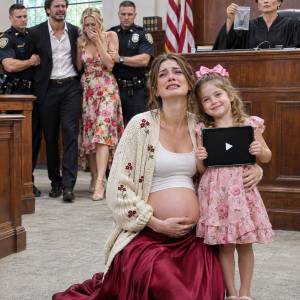
Logan arrived with his attorney and a folder of calendars. He looked tired but confident, and when he saw me sitting beside Caroline, he gave me the same expression he used during our marriage whenever he thought I was being unreasonable.
His argument was straightforward.
I worked too much. He handled most of the children’s daily needs. Raylene had stepped in because I wasn’t available.
At first, he spoke calmly.
“Beth Ann’s a good pharmacist,” he told the court. “Nobody’s denying that. But she works long hours, and the kids need consistency.”
Caroline waited until it was her turn to question him.
“Mr. Corley, did you tell your wife that the children were at your mother’s farm on the day of the accident?”
“Yes.”
“Were they there?”
“No. Plans changed.”
“Did you tell Beth Ann about that change?”
He shifted in his chair.
“I didn’t think it was necessary. Raylene had watched them before.”
“Did Beth Ann know Raylene was regularly caring for the children?”
“She knew I had help.”
Caroline showed him a message he’d sent me on one of my hospital shifts.
Mom’s keeping them until dinner.
“Is that a message you sent your wife?”
“Yes.”
“And was your mother watching the children that day?”
He glanced at the daycare pickup log.
“Apparently not.”
“Who picked them up?”
He looked down.
“Raylene.”
Caroline let the answer settle.
“So when Beth Ann thanked you for arranging childcare, she didn’t know you had sent Raylene?”
“I didn’t think she’d be comfortable with it.”
“Then you knew she might object?”
Logan’s jaw tightened.
“I knew she’d make it into a bigger issue than it needed to be.”
I watched him carefully.
That was the same explanation he’d given me in the hospital.
Caroline turned to the pediatrician’s records.
“Did you request that Beth Ann be removed from the primary contact information?”
“I asked them to call somebody who could answer the phone.”
“Did you tell them she wasn’t involved in the children’s care?”
“I may have said she wasn’t available very often.”
Caroline placed a copy of the appointment history in front of him.
“These records show that Beth Ann scheduled and attended the children’s routine medical appointments. Were you aware of that?”
He looked at the page.
“Yes.”
“And she was the parent who arranged their vaccinations and follow-up visits?”
“Most of the time.”
“So when the office recorded that she wasn’t involved in their care, that wasn’t accurate, was it?”
He didn’t answer immediately.
“No,” he finally said. “Not exactly.”
“Was it accurate at all?”
He looked toward his attorney.
“She did take them to appointments.”
Caroline returned to the contact-change request.
“You also listed Raylene as their mother. Why?”
Logan’s face reddened.
“I didn’t tell them to write that. I said she was helping with the kids.”
“Then why didn’t you correct it when you learned she’d been identified that way?”
He rubbed his forehead.
“I didn’t know it had gone that far.”
“But you knew Beth Ann hadn’t agreed to be removed from the records?”
He stared at the table.
“Yes.”
For the first time that morning, I saw the confidence leave his face.
Caroline asked about the crash next.
“Did you know Raylene had been drinking before she drove the children?”
Logan hesitated.
“She’d had wine at lunch.”
“And you still allowed her to drive them?”
“She seemed fine.”
“Did you tell Beth Ann that Raylene was driving the children that afternoon?”
“No.”
“Why not?”
He looked at me.
“Because she would’ve made a scene.”
I lowered my eyes toward the folder in front of me.
He’d spent months describing me as a mother who wasn’t available, yet his own messages showed that I’d arranged childcare and trusted him to follow through. He’d hidden Raylene’s involvement because he knew I hadn’t agreed to it.
And when his decisions placed our children in danger, he’d blamed my work schedule.
The judge reviewed the evidence, including the crash, the children’s injuries, the misleading contact records, and the circumstances surrounding their care.
Temporary orders kept Ava and Archie primarily with me while the court evaluated longer-term arrangements. Logan’s parenting time was supervised during that period.
I didn’t feel triumphant when the hearing ended.
Ava still missed her father. Archie still asked when Daddy was coming home. I had to explain, over and over, that the adults were working out arrangements and that neither child had caused the problem.
We began seeing a counselor who helped Ava talk about the accident. Some nights she wanted the hallway light left on. Other nights she asked whether I would be the one driving her to school.
I told her I would whenever I could, and I made sure she knew in advance when Grandma June or my mother would be helping.
I adjusted my hospital schedule, trading some weekend shifts so I could spend more time with the children while they recovered. My colleagues helped where they could, and my mother stayed with us for several weeks.
Meanwhile, the criminal investigation continued.
Raylene eventually entered a guilty plea to charges related to impaired driving and the circumstances of transporting the children. Investigators also examined Logan’s decision to let her drive after drinking. He later accepted a plea agreement resolving a child-endangerment charge.
The family court considered those developments alongside the broader evidence about the children’s welfare.
By August, our divorce was final.
The custody order gave me primary physical custody and sole decision-making authority over specified medical and educational matters. Logan’s visits remained supervised, subject to later review, with restrictions on who could transport the children.
It wasn’t the life I’d imagined when I married him.
But it was a plan that put Ava and Archie’s safety first.
Ava’s collarbone healed. The doctor cleared her to return to normal activities, and she was delighted when she could finally climb the playground ladder again.
Archie’s bruising faded much sooner. He went back to being a lively three-year-old who wanted to wear his dinosaur pajamas everywhere, including the grocery store.
Ava still had a small scar above her eyebrow.
One morning, she studied it in the bathroom mirror and announced that it made her look tough.
“You were brave,” I told her. “But you don’t have to be brave every minute.”
She considered that, then asked whether we could have waffles.
I made waffles.
The following month, I took both children to their pediatrician for a routine checkup.
The receptionist handed me a clipboard.
“Mrs. Corley, could you review the emergency contacts and make sure everything is current?”
I looked down at the form.
My name was listed correctly as their mother. Logan’s information appeared in the appropriate section, and my mother’s number was there as an emergency contact.
I checked the entries carefully.
Then Ava leaned across the counter.
“Mommy, can I write something?”
“What would you like to write?”
She pointed at the line with my name.
“I want them to know it’s you.”
I handed her the pen and steadied the clipboard while she wrote in large, uneven first-grade letters beneath the contact information:
MOM: BETH ANN. THE ONLY ONE.
The receptionist smiled.
“That’s very clear, sweetheart.”
I looked at the words for a long moment.
Six months earlier, I’d stood in an emergency department while another woman’s name appeared where mine should have been. I’d spent the months afterward correcting records, answering questions, and proving that my children had never been without their mother.
Now Ava was standing beside me, pleased with her handwriting and impatient to get to the waiting-room fish tank.
I thanked the receptionist, tucked the clipboard beneath my arm, and reached for Archie’s hand.
Ava took my other hand.
Then the three of us walked down the hallway together.