I looked at the man I had lived with for seven years and realized that he was still protecting her from discomfort while I was trying to protect our child from an actual risk.
“Apologize for what?”
“For speaking to her that way.”
“She put industrial scraps and metal over our son.”
“She said she didn’t mean any harm.”
“Then you should go with her.”
Grant stared at me. “You’re going to ruin our marriage over a quilt?”
“No. The quilt just showed me what our marriage was made of.”
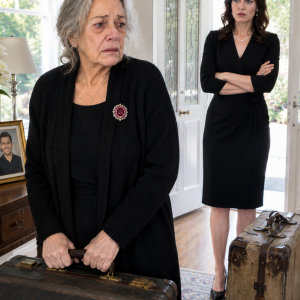
He left with Patricia. For four days, his messages concerned her humiliation and my supposed overreaction. He never asked whether Noah’s fever had improved.
Patricia posted a photograph of herself holding an older quilt and wrote about mothers giving everything only to be rejected. I replied with photographs of the hidden materials and the report. The chat went quiet, and she removed her post.
That evening, my sister-in-law, Allison, called. Her voice was barely above a whisper.
“Rachel, I opened the quilt she gave us two winters ago. There are old coins, bags of sand, and sheets of plastic sewn inside.”
The red quilt had not been an isolated act. It had only been the first one anyone had dared to open.
The Family Inventory

Within a week, relatives in three states opened Patricia’s old quilts. They found dried beans, upholstery stuffing, folded advertising paper, hardened rice, fabric scraps, and coins. Not every quilt contained metal, but almost none held the new cotton she had described each winter.
The quilts were ceremonial objects: photographed, praised, and packed away. Patricia had learned that no one examined a beautiful story if it arrived in bright fabric and carried enough weight.
What unsettled me almost as much as the contents was how quickly relatives began excusing her.
“She meant well.”
“You know how much appearances matter to her.”
“This isn’t worth dividing a family.”
I had heard those excuses when Patricia entered our home unannounced, changed Noah’s formula, ignored his doctor’s instructions, and turned my birthdays into gatherings centered on her. Grant’s solution was always for me to become quieter and less certain of my boundaries.
The quilt had not created that pattern. It had made the pattern impossible to deny.
A week later, Grant returned to find two suitcases beside the front door. When I said I had spoken with an attorney, he looked genuinely bewildered.
“Over one argument with my mother?”
“Over years of arguments that ended with me apologizing so no one else had to change.”
He told me we were a family.
“You and your mother were a family,” I said. “Noah and I were expected to fit around you.”
I reminded him that after I found metal inside our son’s quilt, he tried to stop the testing and demanded an apology for Patricia. He sat down and said he had believed everything would settle if I calmed down.
“That was always the goal,” I told him. “I had to calm down so nobody else had to take responsibility.”
Grant alternated between flowers, promises, anger, and accusations. My attorney advised me: “Document what can be demonstrated. Don’t exhaust yourself arguing about facts you can preserve.”
I kept every message, photograph, medical note, and test result. I stopped trusting the family’s collective memory to be fair to me.
Two months later, Grant told me he had begun counseling and was learning that he had mistaken setting limits with Patricia for betraying her.
“I thought defending her made me a good son,” he said.
“And it left me alone as your wife.”