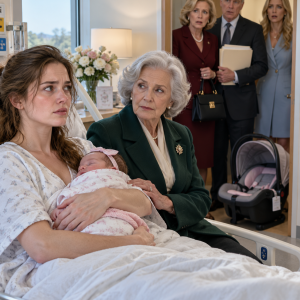
“Hospital donations do not override patient consent,” Dr. Kim replied. “They also do not permit relatives to receive confidential information or interfere with a potential criminal investigation.”
Jonathan finally looked alarmed. “What criminal investigation?”
“Security will escort you to the family waiting area, where investigators may wish to speak with you.”
Margaret refused to move until one officer stepped into the room. Her threats continued into the corridor, shifting from legal consequences to funding decisions, while Jonathan followed with the pale obedience that had defined his entire adult life.
After the door closed, Dr. Kim pulled a chair beside Audrey’s bed.
“Your baby is alive, and the heartbeat remains strong,” she said. “You have bruising, a fractured rib, and signs of placental stress, but the emergency team stabilized both of you.”
Audrey covered her face and released a broken breath that became a sob. For several minutes, she could not speak. The child had survived the fall, the cold, and the lie already being arranged around them.
Dr. Kim waited before continuing. “We also discovered serious inconsistencies between your current results and the records sent by the private clinic. Those records describe a pregnancy that was failing naturally, but our imaging does not support that history.”
“Margaret controlled the clinic,” Audrey whispered. “She chose the physician, approved the appointments, and had every prescription delivered through her office.”
“That is why we repeated the laboratory work,” Dr. Kim replied. “Your blood contains compounds that do not appear on the medication list provided by the clinic. The concentrations suggest repeated exposure over several weeks.”
Part 3 – The Bottles With Different Labels

The hospital placed Audrey under protective access before midnight. Her attorney, Melissa Grant, arrived with a detective from the county’s financial and medical crimes unit. Dr. Kim explained that several compounds in Audrey’s blood could interfere with hormone readings, intensify fatigue, and create symptoms that might be misrepresented as a naturally failing pregnancy.
Investigators collected every bottle Audrey remembered taking. A housekeeper from the estate quietly delivered a canvas bag containing supplements, prescribed drops, and herbal mixtures stored in Audrey’s bedroom. The printed labels listed harmless vitamins, but preliminary testing found that three bottles contained ingredients inconsistent with those labels.
“Who prepared the daily doses?” Detective Marcus Hale asked.
“Margaret’s personal nurse organized them into containers every Sunday,” Audrey answered. “The clinic physician said I should not skip anything because my pregnancy required specialized support.”
Melissa reviewed the clinic release forms and noticed that one document authorized the Bennett Family Office to receive full medical updates. Audrey’s signature appeared at the bottom, although she had never seen the form.
“This authorization was generated two days after your first appointment,” Melissa said. “The electronic signature came from a device registered to Jonathan’s executive assistant.”
Audrey remembered Jonathan insisting that he would handle insurance paperwork because stress was supposedly dangerous for her. At the time, his offer had felt like a small return of kindness. Now it looked like the first unlocked door in a coordinated plan.
The investigation moved quickly because the hospital preserved its original imaging and toxicology records. A search warrant was issued for the private clinic after a nurse contacted authorities and admitted that charts had been edited under instructions from Dr. Simon Vale, the clinic’s medical director.
The nurse provided copies of earlier ultrasound reports showing normal fetal development. Later versions had been altered to describe irregular growth, uncertain cardiac activity, and psychological fixation by the patient. Billing records revealed large consulting payments from a Bennett foundation subsidiary to the clinic during the same period.
Jonathan requested permission to speak with Audrey through their attorneys. Melissa advised against it, but Audrey agreed to a monitored video call because she wanted to hear what he chose to defend when his mother was not physically beside him.
His face appeared on the hospital tablet from a conference room at the family law firm.
“I did not know what was in the supplements,” he said immediately. “Mother told me the clinic was protecting you from complications, and I believed the doctors understood the situation.”
“You signed an authorization in my name,” Audrey replied. “You attended an ultrasound, saw a heartbeat, then allowed your mother to tell me the pregnancy never existed.”
Jonathan rubbed both hands across his face. “Dr. Vale said the first scan might have been unreliable. Mother believed you were planning to use the child to control the divorce settlement.”
“Did you believe that?”
He remained silent long enough to answer.
“I believed you were angry, and I thought you might exaggerate certain things because the marriage was ending badly.”
“You believed that because it protected your affair, your money, and your mother’s version of you.”
“Vanessa has nothing to do with this.”
Audrey almost laughed. “Vanessa was living in the apartment you claimed belonged to corporate guests while I was being given mislabeled medication. Everything you protected is connected, Jonathan, because every lie made the next one easier.”
He leaned closer to the camera. “I never wanted you or the baby harmed.”
“You did not have to want the harm,” Audrey replied. “You only had to keep benefiting from the people causing it.”
She ended the call without waiting for another explanation.
Part 4 – The Plan Hidden Inside the Divorce
Investigators eventually reconstructed the financial motive behind the medical deception. The prenuptial agreement contained a clause establishing a substantial trust for any child born during the marriage, while granting the primary caregiver independent control until the child reached adulthood. It also prevented Jonathan from transferring certain inherited assets if divorce proceedings began during a confirmed pregnancy.
Margaret viewed those provisions as a threat to family control. If Audrey remained pregnant and obtained primary custody, a large portion of Bennett property would move beyond the direct authority of Margaret and Jonathan. If the pregnancy could be described as nonexistent, imagined, or medically ended before formal confirmation, the trust would never activate.
Dr. Vale had therefore been instructed to create uncertainty rather than an obvious medical catastrophe. The altered supplements weakened Audrey, disrupted laboratory patterns, and supported a written narrative describing her as anxious and unreliable. The clinic prepared to recommend psychiatric evaluation if she challenged its findings.
Margaret’s violence beside the pool had not been part of the documented plan. It was an impulsive act that forced Audrey into an independent emergency system, where new imaging and toxicology testing exposed everything the private clinic had been shaping gradually.
A week after the incident, investigators searched the Glasshouse Estate. They found copies of Audrey’s medical records in Margaret’s locked study, along with handwritten notes concerning possible custody strategies, public messaging, and the timing of the divorce. One page contained a list of phrases intended for future legal filings: fabricated pregnancy, unstable attachment, manipulative conduct, and financial coercion.