Jonathan’s name appeared on several meeting schedules involving Margaret, Dr. Vale, and a family attorney. He claimed he attended only because his mother handled the divorce strategy, but recordings recovered from the clinic told a different story.
In one conversation, Jonathan asked whether the records would be convincing enough to prevent Audrey from controlling the child’s trust. Dr. Vale assured him that conflicting tests could create years of legal uncertainty. Jonathan then asked whether the supplements would cause permanent harm.
“Not if the dosage remains controlled,” the doctor replied in the recording. “The objective is instability, not an obvious emergency.”
The recording destroyed Jonathan’s final claim of ignorance. He had known there was a plan to manipulate Audrey’s condition, even if Margaret designed the details.
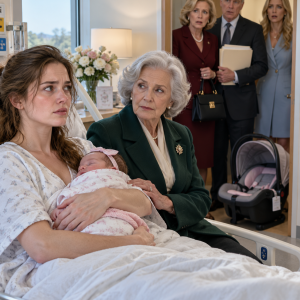
Melissa played the recording once in Audrey’s hospital room, then turned off the device.
“You do not need to listen again,” she said.
Audrey stared through the window at the winter rain moving across the city. “I kept trying to separate the husband I loved from the man who was afraid of his mother. There was never a separation. He chose fear whenever courage became expensive.”
The divorce court issued immediate protective orders preventing Jonathan and Margaret from contacting Audrey or making decisions related to her medical care. The family trust provisions were activated under independent supervision, while Bennett assets connected to the scheme were temporarily frozen.
Margaret was charged in relation to the pool incident, medical coercion, and conspiracy to falsify records. Dr. Vale faced separate professional and criminal proceedings. Jonathan was removed from the executive committee of the family company after outside directors concluded that his conduct created unacceptable legal exposure.
Vanessa ended their relationship within days of the recordings becoming public. Jonathan sent Audrey another letter claiming that he had lost everything because he had been too weak to oppose his mother.
Audrey returned it unopened.
Part 5 – A House Without Permission

Audrey left the hospital after twelve days and moved into a furnished townhouse near the waterfront. The rooms were smaller than those at the estate, but every choice belonged to her. She selected the locks, approved the visitors, arranged her own medical appointments, and chose a new obstetric team with no financial connection to the Bennett family.
Recovery remained difficult. Her rib healed slowly, and recurring nightmares brought back the sensation of sinking beneath black water while Margaret watched from the terrace. Some mornings, Audrey inspected every medication label repeatedly, even after the pharmacist confirmed its contents.
Dr. Kim encouraged her to work with a trauma specialist who understood medical coercion. Audrey initially resisted because she feared that any psychological care could be twisted into proof that Margaret’s accusations had been correct. Melissa reminded her that receiving support was not an admission of instability, but a refusal to let other people define what strength should look like.
During the final months of pregnancy, Audrey began reviewing the charitable grants managed through the Bennett Foundation. She discovered that the private clinic was not the only medical provider financially dependent on Margaret. Several women had submitted complaints about pressure, missing records, and family members receiving confidential information without proper authorization.
Audrey provided those files to investigators and later established an independent legal fund for patients facing medical privacy violations. She did not use the Bennett name in the organization’s title.
The criminal proceedings attracted extensive attention, but Audrey avoided television interviews and refused to describe herself as a symbol of courage. She understood why reporters preferred a simple story about an innocent woman defeating a cruel family, yet the truth had been slower and less elegant. She had doubted herself, accepted medications she did not understand, ignored her discomfort with the clinic, and remained with Jonathan long after recognizing his dishonesty.
None of those decisions made the abuse her fault.
They only proved that manipulation rarely succeeds because its target is foolish. It succeeds because trust, exhaustion, love, and fear can be arranged until resistance feels unreasonable.
Jonathan pleaded guilty to charges involving falsified authorization and conspiracy to interfere with medical records. His cooperation reduced his sentence, although the court denied his request for future decision-making authority over the child. Margaret rejected every offer that required admitting wrongdoing and continued claiming that she had acted to protect the Bennett legacy.
The photograph published after her first court appearance showed her leaving beneath a dark umbrella while reporters called questions from behind metal barriers. She looked smaller than she had beside the pool, not because her clothes or posture had changed, but because the authority surrounding her had disappeared.
Part 6 – The Name Chosen at Sunrise
Audrey’s daughter was born on a clear April morning after fourteen hours of labor. The baby arrived healthy, with a strong heartbeat and a voice that filled the delivery room before the nurses placed her against Audrey’s chest.
Audrey named her Clara Elise Hart, using her grandmother’s first name and Audrey’s original family surname. The choice was not intended as punishment for Jonathan. It was a declaration that the child’s identity would begin with care rather than ownership.
Dr. Kim visited later that afternoon and stood beside the bassinet while Clara slept.
“She appears completely unimpressed by everything required to bring her here,” the doctor said.
Audrey smiled while adjusting the blanket. “That may be the healthiest response anyone has had to this family.”
The legal cases continued after Clara’s birth. Margaret’s attorneys challenged the protective orders, Jonathan requested supervised photographs and updates, and the Bennett company attempted to distance itself from the foundation’s conduct. Audrey allowed her attorneys to answer what required an answer and ignored the rest.
She did not celebrate when Margaret was convicted. Relief came instead as a quiet loosening in her body, the recognition that someone else had finally named the conduct accurately. What happened had not been concern, family protection, medical caution, or an unfortunate misunderstanding. It had been control strengthened by money and disguised as expertise.
One evening several months later, Audrey stood at the window of her townhouse while Clara slept against her shoulder. The sunset reflected across the water in shades of silver and blue, nothing like the dark pool that still returned in dreams.
Melissa sent a final message confirming that the child’s trust had been transferred to an independent institution and that no member of the Bennett family could direct its investments, use it as leverage, or condition access on Audrey’s cooperation.
Audrey read the message, archived it, and placed her phone on the table.
Clara stirred and opened her eyes. Audrey carried her toward the nursery, where soft daylight remained on the walls and no portrait of an ancestor watched from above.
For years, Margaret had treated family as a structure in which authority flowed downward and obedience proved love. Jonathan had accepted that structure because it excused every cowardly decision he made. Audrey intended to teach Clara something different: that family could be built through honesty, boundaries, protection, and the freedom to leave any room where love was used as a form of ownership.
The afternoon beside the Glasshouse pool had nearly ended two lives, but it also destroyed the secrecy that had protected the Bennett family for decades. Margaret believed pushing Audrey into the water would silence a problem. Instead, the fall carried her beyond the family’s controlled doctors, controlled records, and controlled version of reality.
Audrey lowered Clara into the crib and remained nearby until the child settled beneath the blanket. The house grew quiet around them, but the silence no longer resembled isolation. It felt chosen, secure, and entirely their own.
THE END