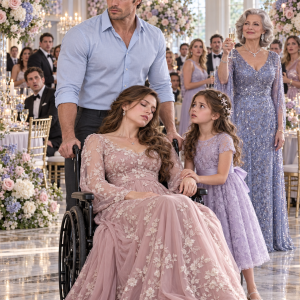
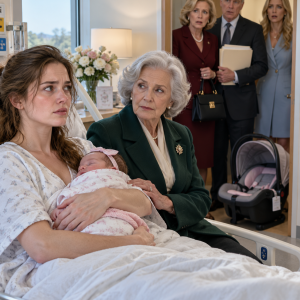
“You called me Eliza while you believed I owned nothing. Do not call me Eleanor because you discovered a price attached to the name.”
Patricia began crying and claimed she had always treated me like a daughter. Walter reminded her that daughters were not drugged, defrauded, or delivered through service corridors.
Celeste remained silent while investigators escorted her away. Her confidence had depended upon controlling which behavior received a diagnosis and which victim appeared believable. Once authenticated records replaced her narrative, clinical language could no longer disguise criminal intent.
Part Four: The Inheritance I Refused to Become
The criminal proceedings lasted nearly two years. Everett and Patricia blamed Celeste for Mae’s death, while Celeste claimed Everett administered the medication. Prosecutors used the hearing-device recording, pharmacy purchases, location records, and recovered messages to establish their shared plan.
Everett was convicted of conspiracy, financial exploitation, unlawful restraint, and felony murder connected to Mae’s death. Celeste received additional convictions for medical fraud and forging the commitment order, while Patricia was convicted for delivering the altered medication and participating in the theft scheme.
Their sentences were lengthy, although no number of years could return the woman who raised me. During my victim-impact statement, I spoke about Mae rather than the fortune they hoped to seize.
“Mae Bell worked in a public library, repaired her own clothes, and saved coins in labeled jars,” I told the court. “You believed her life was small because her bank account was small. However, she preserved a child, a history, and enough truth to defeat three people who mistook wealth for the only form of power.”
The state restored my counseling license after dismissing every fabricated complaint. Families whose identities had been misused received formal apologies and identity-protection support funded by the defendants’ forfeited assets.
I declined immediate executive control and spent one year meeting workers, managers, scientists, pension representatives, and communities affected by Mercer decisions.
Walter taught me the history behind the pocket watch. Thomas Mercer commissioned it when I was born and planned to place it inside a lighthouse time capsule. After the harbor collision, Mae found it fastened inside my blanket and preserved it as the only object connecting me to my parents.
The trust investigation uncovered why Mae remained afraid for decades. A former executive had arranged the collision to seize voting control, although he died before investigators could prosecute him. His allies had since left the company, but Mae never knew whether the danger had ended.
I refused to hide that history to protect the Mercer reputation. The company published an independent report, compensated affected employees, and created permanent whistleblower protections supervised outside executive management.
I also restored my legal name without erasing Mae’s. My identification now read Eleanor Mae Mercer, joining the woman who gave me life with the woman who preserved it.
Part Five: Light Kept for Someone Else

The following spring, the museum gala returned without private officers, forged court papers, or donors applauding a public humiliation. The portrait gallery displayed a new photograph of Mae beside Thomas and Katherine Mercer.
I converted the mansion attached to the museum into the headquarters of the Mae Bell Initiative, a nonprofit supporting young adults leaving foster care, workers facing professional retaliation, and people defending themselves against abusive guardianship petitions.
The program provided housing, legal representation, career-license defense, and independent medical evaluations. I understood that inheritance mattered most when it gave other people room to remain legally visible.
Walter attended the opening with the pocket watch secured inside a glass display. Beneath it, the museum placed Mae’s sentence from the recording: GOOD PEOPLE DO NOT IMAGINE CRUELTY QUICKLY ENOUGH.
I added another line below it: THEY CAN STILL LEARN TO RECOGNIZE IT.
Several former students came to the ceremony after my license was restored. One young woman asked whether I intended to return to school counseling now that I controlled a billion-dollar trust.
“Money changed the number of doors I can open, but it did not change the work that taught me why doors matter,” I answered.
I returned to counseling two days each week while overseeing the initiative and serving as trust chair. The arrangement confused executives accustomed to treating direct service as something successful people escaped.
My first major trust vote required every Mercer facility to fund confidential mental-health care through providers independent of company management. No executive could access treatment records, use diagnoses during employment disputes, or choose evaluators for contested capacity proceedings.
On the anniversary of Mae’s death, I visited the Providence duplex where she raised me. I kept the home rather than replacing it with a monument, allowing the initiative to use it as transitional housing for two young women leaving foster care.
One resident found me repairing the loose pantry hinge Mae had complained about for years.
“You own shipyards, so why are you fixing a cabinet yourself?”
“Because Mae taught me that ownership means noticing what needs care rather than waiting for someone less powerful to handle it.”
At sunset, I carried the pocket watch to the lighthouse overlooking Newport Harbor. Julian and Walter accompanied me while museum staff opened the time capsule Thomas had prepared before the accident.
Inside were letters to the daughter he expected to watch grow up. He wrote about ships, responsibility, and the danger of allowing family companies to treat workers as replaceable machinery.
The final letter contained one sentence I read repeatedly.
“If you inherit anything from me, Eleanor, let it be the obligation to leave a light burning for someone who has not reached shore.”
I placed a copy of Mae’s photograph beside the letters and sealed the capsule again. The original remained with me because neither history nor grief required surrendering every personal object to public display.
Everett had believed my identity mattered only after it became valuable. Celeste believed authority allowed her to transform resistance into illness, while Patricia believed a frightened woman without family could be erased quietly.
They misunderstood both my identity and Mae’s protection. I had never been valuable because genetic testing connected me to Mercer Maritime, and I had never been powerless because Everett emptied my accounts.
My value existed during every exhausted counseling session, every night Mae waited beside the window, and every moment I continued documenting harm after powerful people called documentation delusion.
Before leaving the lighthouse, Walter returned the pocket watch to my hand.
“Your father intended this to tell time, but Mae used it to carry truth across thirty-four years.”
I closed the engraved cover and listened to its steady movement.
The gala floor where Everett tried to remove me now welcomed people whose names had been dismissed, changed, or deliberately forgotten. The fortune he wanted became a defense against the kind of coercion he attempted.
I could not restore the years Mae spent afraid or give my biological parents the future stolen from them. However, I could decide what happened after the truth arrived.
The lighthouse beam moved across the dark water, disappeared, and returned according to its faithful rhythm. It did not shine because every ship was already safe.
It shone because someone might still be searching for the shore.
THE END