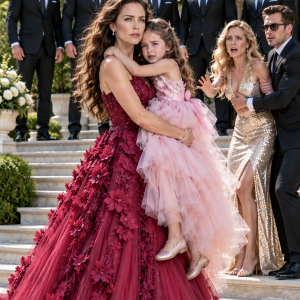
Part 1 – The Anniversary Dinner
For eight years, everyone in my husband’s family had treated our childlessness as a private failure that somehow belonged only to me. Every holiday carried another question, every birthday ended with another recommendation, and every medical appointment became evidence that I had failed to provide the future my husband believed he deserved.
That was why our eighth-anniversary dinner felt almost theatrical from the moment I entered the dining room of our Lake Forest home outside Chicago. My mother sat rigidly beside the fireplace, while my husband’s mother, Margaret Holloway, looked as though she had been summoned to a funeral. Twelve relatives occupied the long table, pretending the candles, white roses, and crystal glasses meant we were celebrating a marriage instead of preparing to bury it.
Then my husband, Grant Holloway, entered carrying one newborn twin while my younger sister, Natalie, followed with the other.
Natalie wore a cream dress I had purchased for her six weeks earlier. She smiled with the soft confidence of someone who believed the entire room had already chosen her side. The twins slept against their shoulders, wrapped in blue-and-white blankets embroidered with the Holloway family initials.
Grant raised a champagne glass before anyone could ask a question.
“For eight years, I begged my wife to give me a family,” he announced. “Natalie accomplished in one year what Caroline never could.”
The room went silent with the kind of politeness wealthy families use when cruelty becomes inconvenient but entertaining. My mother lowered her eyes, perhaps from shame, perhaps because she had known. Margaret’s face lost its color completely.
Natalie tilted her head and smiled toward me.
“Some women are naturally meant for motherhood, while others are better suited to numbers and offices.”
I had paid the rent on Natalie’s apartment, cleared her student debt, and hired her into the finance department at Aurora Health Systems. I had defended her after missed deadlines, covered her counseling expenses, and introduced her to executives who later praised her ambition. Watching her hold one of the twins, I understood that gratitude had never existed where entitlement had been carefully fed.
Grant placed a folder beside my untouched plate.
“The divorce agreement is straightforward. I keep the house, the lake property, and my equity in Aurora. You keep your salary and whatever remains in your personal accounts.”
My attorney, Helen Price, sat two seats away as an invited family friend. She did not move, and neither did I.
I opened the folder, read the final page, and signed where Grant’s attorney had placed a yellow tab.
His expression changed immediately.
He had expected tears, bargaining, or a public collapse. Natalie had clearly expected me to defend my place as Grant’s wife, thereby proving that I still wanted a marriage he had already replaced.
“That is all?” she asked.
“That is all,” I answered.
Grant laughed, kissed Natalie’s temple, and carried the nearest twin toward the entrance hall.
“I knew you would eventually behave rationally.”
I watched him leave the home purchased through my grandmother’s trust before my marriage. Then I gathered every glass Grant, Natalie, and the twins had used and placed them inside evidence bags Helen had brought in her briefcase.
Margaret seized my wrist.
“Caroline, please do not do this.”
I looked at the woman who had spent eight years watching me accept blame for something that had never been mine.
“You asked me to protect him, and I protected him longer than anyone deserved.”
Her eyes filled with tears.
Nine years earlier, after Grant completed treatment for testicular cancer, a fertility specialist had confirmed that he was permanently sterile. Margaret begged the physician to tell Grant only that his chances were extremely low. She later begged me to preserve the lie because his identity, confidence, and relationship with his father depended upon the belief that he could eventually have children.
I accepted injections, procedures, surgeries, and endless questions while Grant watched me apologize for failing him. He never knew the treatments were largely pointless because his mother and I had constructed a silence around his pride.
Now he had publicly claimed children he could not possibly have conceived.
My phone vibrated beneath the table. The private laboratory confirmed that the samples had entered chain-of-custody processing.
Grant believed my signature had ended the contest. In reality, it had authorized the first audit of his life.
Part 2 – What The Signature Actually Meant
Grant moved Natalie and the twins into Margaret’s town house that same evening. Before midnight, he sent photographs showing Natalie in silk pajamas beneath a banner reading Welcome Home, while Grant held a bottle beside one sleeping infant.
His message arrived seconds later.
“You should appreciate that I am not requesting spousal support.”
I forwarded everything to Helen and went to Aurora’s headquarters before sunrise.
Aurora Health Systems was not Grant’s company, although he described it that way whenever donors or journalists were listening. My grandmother, Eleanor Bennett, had created the original medical investment trust, while I had transformed its struggling hospital assets into a national diagnostics and research network. The family trust held sixty-four percent of Aurora’s voting shares in my name.
Grant received an executive strategy title after our wedding because I wanted him to possess a career independent from his father. Over time, he confused proximity to ownership with ownership itself.
For six months, I had been investigating irregular payments approved through his division. Eleven million dollars had moved from Aurora into three consulting companies that produced no measurable work. Two companies were controlled through Natalie’s former college roommate, while the third belonged to Grant’s closest friend, Derek Mason, Aurora’s vice president of acquisitions.
The invoices described market research, integration planning, and international compliance reviews. Their supporting documents contained copied paragraphs, invented personnel, and addresses leading to the same rented mailbox in Evanston.
Grant had authorized every payment.
Natalie received almost three million dollars, while Derek controlled the remainder.
Their plan was not limited to adultery. They had been draining Aurora before the divorce, assuming Grant’s imaginary equity would allow them to hide the losses once I surrendered control.
At noon, Grant entered the executive floor with Natalie beside him. She wore a red dress and carried one twin, while a nanny followed with the other. Employees stopped speaking as they crossed the reception area.
Grant pointed toward my office.
“Have security clear Caroline’s belongings. Natalie wants this room because it has the best view.”
The security director looked toward me from across the lobby. I nodded once, allowing the scene to continue.
Natalie approached until her perfume overwhelmed the clean office air.
“You always believed intelligence made you untouchable.”
“No,” I replied. “Documentation makes people difficult to remove.”
Grant threw the signed agreement onto the conference table.
“She surrendered everything last night.”
Helen opened the document calmly.
“She agreed to dissolve the marriage. Property division remains governed by the prenuptial agreement you signed nine years ago.”
Grant’s smile disappeared.
Our agreement contained an infidelity clause, a financial misconduct clause, and a provision canceling every unvested benefit connected to my trust if Grant committed fraud or concealed marital assets. His executive title, options, housing allowance, and access to the lake property could disappear immediately upon verified evidence.
Natalie tightened her hold around the infant.
“Grant has children to support.”
I looked at the twins before answering.
“That remains to be established.”
A laboratory courier arrived with a sealed envelope. Margaret followed him into the conference room, trembling so noticeably that she had to steady herself against the door.
Grant frowned.
“Mother, why are you here?”
Margaret looked from him to the babies, then toward me.
“Wait,” she whispered. “Caroline has not told you?”
Part 3 – The Secret Margaret Protected

Grant laughed once, although nobody else joined him.
“Told me what?”
I placed his original fertility report beside the newly delivered DNA results.
“Your cancer treatment left you permanently sterile before our wedding. According to the DNA analysis, neither twin is biologically related to you.”
The room became completely still.
Natalie stepped backward.
“Those tests are fraudulent.”
Helen removed the chain-of-custody documentation.
“The samples were collected from drinking glasses and feeding bottles preserved immediately after use. A court-approved laboratory processed them under documented procedures.”
Grant stared at his mother.
“You knew?”
Margaret covered her mouth, crying too hard to speak.
“She knew,” I answered. “I knew, and your specialist knew. Your mother believed the truth would destroy you, so I allowed everyone to blame me instead.”