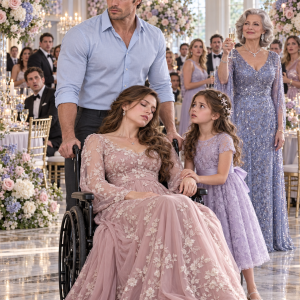
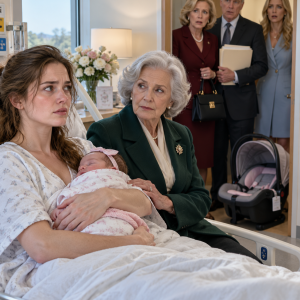
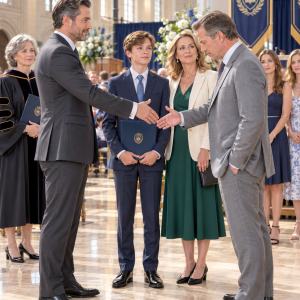
“This isn’t possible.”
“You seemed very certain when you signed those papers.”
Brooke rose abruptly and moved toward a side door, but two federal investigators stepped into the aisle. Several more agents who had been seated among the guests stood and displayed their credentials.
No one shouted. No one was thrown to the floor. The investigators simply surrounded Mason and Brooke with the calm efficiency of people who had prepared carefully.
The lead investigator addressed Mason.
“You are being taken into federal custody in connection with insurance fraud, conspiracy, aggravated assault, and filing false statements. You have the right to remain silent.”
Mason looked from the agents to the signed document and then back to me.
“Rachel, listen to me. I panicked. The weather was bad. I didn’t know what I was doing.”
For years, his explanations had made me question my own memory. That afternoon, they sounded small and poorly rehearsed.
“You knew exactly what you were doing,” I said. “You just believed I would never be able to tell anyone.”
Brooke began insisting that everything had been Mason’s idea. Mason immediately blamed Brooke. Their loyalty lasted less than a minute once the future they had planned began slipping away.
As the agents escorted them from the chapel, Mason called my name again.
I did not turn around.
Instead, I looked at the photograph near the altar and thought about the woman smiling from inside its gold frame. She had been trying so hard to appear happy that she had almost forgotten happiness was supposed to be real.
I wished I could have told her that she was going to be all right.
The Life Waiting Beyond Him

The legal proceedings lasted seven months.
The evidence included Mason’s signed claim, his recorded statements, financial messages between him and Brooke, the recent policy changes, location data from their phones, and testimony from the investigator who had watched them return to the lodge without me.
A jury found them responsible on every major count. Both received lengthy federal sentences, and Mason’s business holdings were sold to satisfy court-ordered restitution and outstanding debts.
By then, I had moved with Henry to Thomas’s estate near Lake Geneva, Wisconsin.
The property was large, but what mattered to me was not its stone terraces, private gardens, or guarded entrance. What mattered was the quiet.
No one checked my phone.
No one criticized how long I spent with friends.
No one made affection feel like a prize that could be withdrawn whenever I spoke too honestly.
Thomas and I learned how to become family in small, ordinary ways. He made terrible pancakes on Sunday mornings. I teased him about owning six identical navy sweaters. He walked Henry through the gardens every afternoon, narrating business news as though an infant could offer useful financial advice.
He also invited me to join the board of his company, but he did not pressure me to accept.
“You have inherited opportunities,” he told me, “not obligations. Build the life that belongs to you.”
Eventually, I accepted a role overseeing the company’s charitable foundation. We expanded emergency housing and legal-support programs for parents escaping controlling homes. I never used my own experience as a marketing story. I simply remembered how difficult it had once been to imagine a door opening, and I helped build doors for others.
On Henry’s first birthday, Thomas gave me a leather folder containing updated estate documents. A protected trust had been established for Henry’s future, and I had been named Thomas’s successor should I ever choose to lead the company.
“This is not payment for what happened,” he said. “Nothing could repay that. This is simply what should have been yours all along: the freedom to choose.”
Almost a year later, an email arrived from Mason’s public defender.
Mason wanted me to write a letter supporting his transfer to a less restrictive facility. According to the message, he was struggling with isolation and believed my compassion might persuade the court.
I left the email unopened for several days.
Then, one warm afternoon, I carried my phone onto the terrace while Henry played nearby with wooden blocks. For a moment, I remembered the white silence of the mountain and the sound of Mason’s footsteps moving away from me.
The memory was clear, but it no longer controlled my breathing. My hands remained steady.
I realized I did not hate him.
Hatred would have required keeping him present in my life, and I had no space left for him there.
I deleted the message without replying.
The court could decide where Mason belonged. His comfort was no longer my responsibility, just as my fear was no longer his possession.
Henry looked up and held his arms toward me.
I lifted him, and he rested his warm cheek against mine. Through the open doors behind us came the sound of Thomas arguing cheerfully with a cook about the correct way to prepare birthday cake, even though the birthday had already passed.
For most of my marriage, I had believed survival meant enduring whatever happened and remaining unchanged.
I knew better now.
Sometimes survival means allowing an old version of yourself to remain behind—the frightened woman who apologized too often, doubted what she saw, and mistook control for love—while the person who rises afterward walks forward without asking permission.
Mason had taken me to the mountain believing the snow would silence me and turn my life into money.
Instead, the mountain returned my voice, brought my father back to me, and placed my son safely in my arms.
He thought he was writing the final chapter of my story.
He had only introduced me to the woman who would finish it.