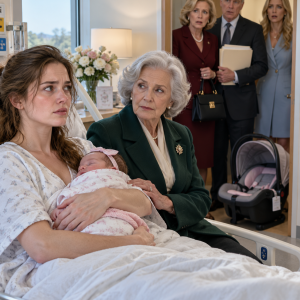
“Your father told me that if anything complicated ever happened with the Reddick family, I should call Ms. Wren.”
My father had passed away eight years earlier, before I met Corbin.
I stared at her.
“My father knew your name?”
Cecily opened a leather folder.
“He knew Corbin’s grandmother.”
Corbin’s grandmother, Lenora Reddick, had been the most respected and feared person in the family.
She was elegant, intelligent, and impossible to impress.
Most people became nervous around her.
For some reason, she had liked me.
During our monthly lunches, she asked more questions about my childhood than about my marriage. She wanted to know whether I trusted Corbin, whether I had kept my own bank account, and whether I still worked with children.
Once, she had told me:
“Wealth can protect a family, Renee, but it can also convince weak people that consequences are optional.”
At the time, I thought she was simply warning me about privileged relatives.
Cecily placed several documents across my blanket.
“Lenora amended the family trust before she passed away,” she said. “The amendment includes a conduct provision.”
The provision addressed abandonment during a serious medical emergency, manipulation of family records, and failure to support direct descendants.
If Corbin violated those conditions, he could lose control over major trust assets.
I stared at her.
“Lose control to whom?”
“To the protective guardian of his children.”
My mother leaned closer.
“And who is that?”
Cecily looked directly at me.
“You, unless a court finds you incapable of serving.”
For the first time since waking, I felt something other than sorrow.
I felt a small opening.
Not victory.
Possibility.
The Three Children Waiting Behind Glass
Later that day, the doctors allowed me to visit the neonatal unit in a wheelchair.
Every movement hurt, but I barely noticed.
My sons, Everett and Hollis, slept in separate incubators beneath small blue blankets. My daughter, Maisie, wore a pale pink cap that was too large for her head.
They were smaller than I had imagined.
Perfect, but fragile.
I placed one finger into Everett’s palm.
He closed his hand around it.
The strength of that tiny movement broke something open inside me.
“Hello, sweetheart,” I whispered. “I am here now.”
My mother stood behind me, crying silently.
Hollis moved his foot beneath his blanket. Maisie turned her head slightly when I spoke.
In that room, surrounded by quiet machines and gentle nurses, I made myself a promise.
Corbin could end our marriage.
He could choose another woman.
He could try to rewrite the story of our family.
But he would not turn my children into legal pieces on a board.
The Settlement That Asked Me to Disappear
Corbin came to the hospital that evening.
He wore a charcoal suit and a dark overcoat, as though he had arrived for a board meeting rather than a conversation with the woman who had nearly lost everything giving birth to his children.
Cecily and my mother remained in the room.
Corbin disliked that immediately.
“I hoped we could speak privately.”
“No,” I said.
He placed a folder on the bedside table.
“I am offering you a generous arrangement. A home, full medical coverage, household staff, and long-term support.”
Cecily opened the folder.
After reading several pages, she looked up.
“This agreement requires Renee to accept restricted access to the children, waive any challenge to the timing of the separation, surrender all claims connected to the family trust, and agree never to speak publicly about what happened.”
Corbin’s jaw tightened.
“It protects everyone involved.”
“It protects you,” I said.
He turned toward me.
“You need to think practically.”
I almost laughed.
“I am thinking practically. I am protecting my children from the man who tried to make decisions about them before I even woke up.”
“No one is taking them from you.”
“Then remove every custody restriction from the agreement.”
He said nothing.
That silence answered more clearly than words.
I pushed the folder away.
“No.”
“You have not reviewed all the benefits.”
“I have reviewed the cost.”
For a moment, Corbin’s calm expression slipped.
“You are making a mistake.”
“My mistake was believing your need for control was the same as strength.”
Before he left, I asked him one final question.
“Have you seen the babies?”
He looked toward the door.
“I have received medical updates.”
“Have you stood beside them?”
His shoulders became rigid.
“No.”
Then he walked away.
Lenora’s Final Warning
The following morning, Cecily brought me an envelope from Lenora’s private archive.
My full married name was written across the front.
Inside was a letter.
Lenora wrote that if I was reading it, then someone in the family had chosen power over loyalty. She told me not to blame myself for trusting my husband. She reminded me that betrayal did not make love foolish; it only revealed the weakness of the person who betrayed it.
Near the end, she wrote:
“Protect the children before you protect the family name. And ask why Corbin needed the marriage to end before the third child’s birth was formally entered.”
I read the line three times.
The third child.
Maisie.
Cecily requested the preliminary birth records.