Everett and Hollis were listed correctly.
Maisie’s record was incomplete.
The section identifying her father had been left blank during the first digital entry, and someone had accessed the record within an hour of her birth.
That evening, I received a message from an unknown number.
Stop asking questions. Corbin was trying to protect the future of everyone involved.
Cecily photographed the message.
“Do not answer,” she said.
“Was it Sloane?”
“Most likely.”
“What could Maisie’s record possibly change?”
Cecily closed the folder slowly.
“Control of the entire trust.”
The Eleven-Minute Plan

The answer was hidden in a provision Lenora had called the Three-Heir Protection Clause.
If three direct descendants were born from the marriage, control of the family’s voting shares and protected assets would move into a separate trust managed by the children’s primary guardian.
Corbin would no longer control the company, the properties, or the inheritance intended for the next generation.
The birth records showed that Everett arrived at 11:42 a.m.
Hollis arrived at 11:44.
My condition then became unstable, delaying Maisie’s delivery until 11:53.
The electronic separation documents had been submitted at 11:48.
Between the second and third birth.
Corbin and Sloane believed they could argue that the marriage had ended when only two children had been born.
They had tried to divide one pregnancy into two legal timelines.
There was only one problem.
Submitting documents did not immediately end a marriage, especially when one spouse had not agreed, had not been represented, and was unconscious during a medical crisis.
All three babies had been born while our marriage remained legally intact.
Their plan had failed before I even woke up.
The Meeting That Changed the Reddick Family
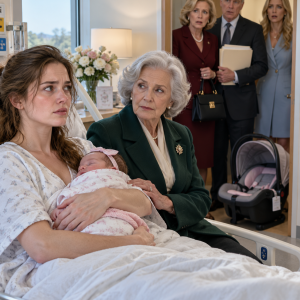
Five days later, the trust representatives came to my private recovery room.
Corbin arrived with Sloane.
She wore a cream designer coat and carried an expensive leather handbag. At first, she looked confident.
Then she saw Cecily and the two trust officials.
Her confidence disappeared.
“What is this?” Corbin asked.
Cecily placed the hospital timeline and digital records on the table.
“At 11:48 a.m., documents were submitted through an account connected to your office. That happened after the birth of your second child and before the birth of your third.”
Sloane’s face turned pale.
Corbin looked at her.
“You said the timing would protect the assets.”
She stepped back.
“I was trying to protect our future.”
One of the trust officials, Lawrence Pike, adjusted his glasses.
“The attempt activated multiple conduct provisions. The documents were not valid as a completed separation, and the Three-Heir Protection Clause remains fully enforceable.”
Corbin stared at him.
“I am the primary trustee.”
“You were,” Lawrence replied.
The room became silent.
“Your voting authority has been suspended. Your discretionary accounts are frozen pending review. The primary residence, investment properties, and controlling shares have moved into the children’s protective trust.”
Corbin looked toward me.
“You cannot take my company.”
“It was never entirely yours,” I said. “You inherited responsibility, and you treated it like ownership.”
Sloane turned toward him.
“Are the accounts really frozen?”
Corbin did not answer.
That was all she needed.
She picked up her handbag.
“I cannot be part of this.”
Then she left without touching his arm or looking back.
Corbin watched the doorway for several seconds.
In one brief moment, he finally understood what he had traded away.
His wife.
His three newborn children.
His grandmother’s trust.
His reputation.
And the moment the money became uncertain, the woman he had chosen abandoned him too.
“Renee,” he said quietly. “We can still fix this.”
I looked at the photographs of my babies on the bedside table.
“Some things can be repaired,” I said. “But they cannot be returned to the way they were.”
A Home Built on Safety

Two weeks later, I left the hospital.
My mother carried Everett. Cecily held Hollis. I carried Maisie against my chest beneath a soft rose-colored blanket.
The morning air was cool and clean.
For the first time in months, I did not feel afraid of what came next.
The trust would protect my children financially, but I no longer saw the money as a prize. It was simply a shield.
What mattered most was that Everett, Hollis, and Maisie would grow up knowing they had never been unwanted, never been inconvenient, and never been liabilities.
As we approached the waiting car, I looked down at my daughter.
“We are going home,” I whispered.
She moved one tiny hand against my collarbone.
Lenora had been right.
A family legacy should not be measured by the name on a building or the amount held in an account.
It should be measured by the people who feel safe inside it.
And for the first time, I knew exactly what kind of family I intended to build.
A person’s true character is often revealed not during easy years filled with comfort and promises, but during the frightening moments when loyalty requires sacrifice and no audience is present to offer praise.
Trusting someone is not a sign of weakness, because the shame of betrayal belongs to the person who chose dishonesty, not to the person who entered the relationship with an open and sincere heart.
Money may provide comfort, education, housing, and security, but it cannot create loyalty in someone who values control more than love or appearances more than family.
A mother can feel frightened, exhausted, heartbroken, and uncertain while still finding enough courage to stand between her children and anyone who tries to treat their future as a business negotiation.
The strongest response to betrayal is not always revenge, because sometimes the greatest victory is simply refusing to surrender your dignity, your voice, and the people who depend on you.
People who believe they can control every outcome often forget that the truth has its own timing, and one honest document, one careful witness, or one hidden safeguard can undo years of manipulation.
Children should never be treated as leverage, liabilities, or pieces in an argument, because every child deserves to grow up knowing that their value was never dependent on wealth, status, or convenience.
Leaving an unhealthy relationship does not mean a family has failed, because a peaceful home built on respect is far stronger than a beautiful home held together by fear, secrecy, and emotional neglect.
A meaningful legacy is not defined by who inherits the largest account or controls the most powerful company, but by whether the next generation receives enough protection, wisdom, and love to become better than the generation before them.
Even after betrayal changes everything you believed about your past, you still have the power to decide what your future will become, whom you will protect, and what kind of story your children will one day remember.