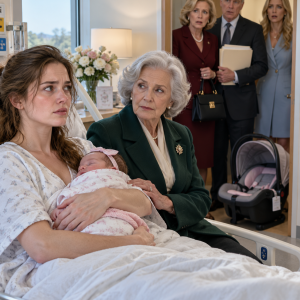
The Woman in Room 614
The first time Grant Holloway saw his ex-wife after the divorce, she was asleep beneath a gray hospital blanket with one hand resting protectively over the curve of her stomach.
For several seconds, his mind refused to understand what his eyes were seeing.
Then Laurel opened them.
The color drained from her face.
Grant stood frozen in the doorway of Room 614, still holding the leather portfolio he had come to deliver to a cardiologist two floors down. Outside, a hospital cart rattled past. Somewhere nearby, an elevator chimed.
Inside the room, nothing moved.
Except Laurel’s fingers.
They tightened over her abdomen.
“You shouldn’t be here.”
Her voice was weak, but the words landed with the force of a slammed door.
Grant looked at the monitor beside her bed, at the IV line disappearing beneath the sleeve of her hospital gown, and finally at the unmistakable swell beneath the blanket.
“How far along are you?”
Laurel turned her face toward the window.
Rain streaked the glass, blurring the city into silver lines.
“That’s not your concern anymore.”
Two months earlier, Grant had signed divorce papers at the same walnut dining table where they had once planned a nursery.
The papers had been uncontested.
So had the ending.
After twelve years together, two miscarriages, and eighteen months of living like careful strangers, they had stopped fighting for something neither of them knew how to repair.
Grant had convinced himself the divorce was merciful.
Standing in that hospital room, he understood mercy had nothing to do with it.
“Is the baby mine?”
Laurel closed her eyes.
That was answer enough.
Grant set the portfolio down without looking.
“Why didn’t you tell me?”
“Because you were finally sleeping again.”
Her words were quiet.
He almost missed them.
“What does that mean?”
She opened her eyes and looked at him fully now.
Laurel had always been pale, but this was different. Her skin held a translucent stillness. Faint bruises shadowed the inside of both arms. Her dark hair, once thick enough to clog every shower drain in the house, had been cut bluntly at her shoulders.
Grant felt something cold move through him.
“What’s wrong?”
Laurel’s mouth trembled, then hardened.
“Go home, Grant.”
“Tell me what’s wrong.”
Before she could answer, a nurse stepped into the room.
She was in her fifties, with silver-streaked braids and the alert expression of someone accustomed to reading danger before anyone named it.
“Ms. Mercer, your hematologist is on the way.”
Her gaze shifted to Grant.
“Family?”
Laurel answered first.
“No.”
Grant answered at the same time.
“Yes.”
The nurse looked between them.
Laurel gave a tired laugh that held no humor.
“That’s sort of the problem.”
The Diagnosis She Hid
Dr. Priya Shah arrived ten minutes later carrying a tablet and an expression too careful to be reassuring.
Laurel tried to make Grant leave.
He refused.
They argued in clipped whispers until the doctor closed the door and pulled a chair closer to the bed.
“Ms. Mercer, stress is not helping your blood pressure.”
“Neither is my ex-husband.”
Grant ignored that.
“What is happening to her?”
Dr. Shah looked to Laurel for permission.
Laurel stared at the rain.
Finally, she nodded once.
The doctor folded her hands.
“Laurel has a rare autoimmune blood disorder. Her body is destroying platelets faster than it can replace them.”
Grant glanced toward the bruises on her arms.
“Can it be treated?”
“Usually, yes. Pregnancy complicates it.”
The room seemed to narrow around him.
“How much?”
Dr. Shah did not soften the truth.
“Enough that we are monitoring both mother and babies very closely.”
Grant turned toward Laurel.
“Babies?”
Laurel’s eyes closed.
Dr. Shah stopped speaking.
For one extraordinary second, Grant heard nothing—not the rain, not the monitor, not his own breath.
“Twins?”
Laurel looked at him again.
Tears had gathered in her eyes, but none fell.
“Two girls.”
The words broke something open inside him.
He sat down because his knees no longer trusted him.
For years, grief had occupied their marriage like a third person. It slept between them. Ate dinner with them. Followed them into every doctor’s office and holiday gathering.
After the second miscarriage, Laurel stopped entering the spare bedroom at the end of the hall.
Grant stopped asking why.
Months later, when she quietly boxed up the tiny knitted blanket his mother had given them, he stood in the doorway and said nothing.
He had thought silence was kindness.
Now he saw it for what it had been.
Abandonment.
“When did you find out?”
“Three days after you moved out.”
He stared at her.
“And the illness?”
“Six weeks ago.”
“You’ve been dealing with this alone for six weeks?”
Laurel’s expression sharpened.
“I’ve been dealing with things alone for much longer than that.”
Dr. Shah stood.
“I’ll give you both a minute.”
After she left, Grant remained in the chair beside the bed.
He could smell the faint citrus soap Laurel had used for years. The familiarity of it made the hospital room feel suddenly unbearable.
“Why didn’t you call me?”
Laurel looked down at her hands.
“Because I knew what you would do.”
“What would I do?”
“Exactly this.”
She gestured toward him.
“You’d show up. You’d take over. You’d turn it into a problem you could solve because that would be easier than admitting we broke each other.”
Grant leaned forward.
“You’re carrying my daughters.”
“I was carrying your children before, too.”
The sentence struck with surgical precision.
Grant flinched.
Laurel’s face crumpled for only a second before she looked away.
“I’m sorry.”
He barely recognized his own voice.
“I should have been there.”
“You were there.”
She shook her head.
“That was the worst part. You were standing right beside me, and I still felt completely alone.”

The Life He Tried to Buy Back
Grant did not go home that night.
He sat in a vinyl chair beside Laurel’s bed while she slept, answering emails in the dark and watching the numbers on her monitor change.
At 2:17 a.m., one of the babies kicked.
Laurel stirred and caught his hand before he could move away.
Still half asleep, she placed his palm against her stomach.
The movement came again.
Small.
Defiant.
Grant lowered his head.
He cried so quietly Laurel pretended not to notice.
By morning, he had canceled three meetings, postponed a land acquisition, and instructed his financial adviser to liquidate a lake property in Vermont.
When Laurel found out, she was furious.
“You are not selling anything.”
“The treatment Dr. Shah recommended isn’t covered under your plan.”
“I know.”
“Then you know why I’m selling.”
“Because sacrifice makes you feel noble.”
Grant stopped.
They were alone again, breakfast untouched between them.
“That’s not fair.”