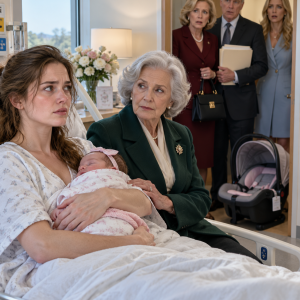
“No, Grant. Fair would have been you sitting with me on the bathroom floor after we lost the first baby instead of going back to work because you didn’t know what to say.”
He looked down.
Laurel’s voice softened, which somehow hurt more.
“Fair would have been me telling you I blamed myself instead of pretending I was fine. We both failed. But you don’t get to rewrite that by setting fire to your life now.”
“It’s my life.”
“Not anymore.”
Her hand moved to her stomach.
“These girls need a father who still has something left when they arrive.”
Grant looked at her.
“They need a mother who arrives with them.”
Laurel went still.
Neither spoke after that.
Later that afternoon, Dr. Shah introduced them to Dr. Owen Beck, a maternal-fetal medicine specialist from a private institute outside Milwaukee.
He was polished, precise, and almost too calm.
He explained a specialized therapy that could reduce Laurel’s immune response without threatening the pregnancy. It was experimental in cases this advanced, but their early results were promising.
“How soon can we start?” Grant asked.
Dr. Beck glanced at Laurel.
“There are administrative hurdles.”
“What kind?”
“The institute’s board reviews high-risk admissions. Funding, liability, eligibility.”
Grant leaned back.
“How long?”
Dr. Beck hesitated.
“Possibly two weeks.”
Laurel gave a brittle laugh.
“I may not have two weeks.”
Dr. Beck’s expression did not change.
“I’m aware.”
Grant noticed something then.
Not fear in the doctor’s face.
Recognition.
Dr. Beck had looked at Laurel the way someone looks at a name they have seen before.
The Empty Bed
For the next nine days, Grant rebuilt his life around Room 614.
He learned which tea Laurel could keep down and which nurse slipped her extra crackers after midnight. He attended every appointment. He took notes. He stopped trying to fill every silence.
Sometimes Laurel let him read to the babies from the paperback mystery novels she loved.
Sometimes she asked him to leave.
He always came back.
Then, on the tenth morning, Grant arrived carrying coffee and found the room empty.
The bed had been stripped.
The IV pole stood abandoned near the wall.
Her overnight bag was gone.
For one disorienting moment, he thought she had died.
Then Nurse Alvarez hurried in.
“She checked herself out forty minutes ago.”
Grant stared at her.
“Why would you let her do that?”
“She is mentally competent and legally entitled to refuse treatment.”
“She can barely walk across the room.”
“She had help.”
Grant’s stomach tightened.
“Who?”
The nurse shook her head.
“A car service. She signed the forms and left.”
Grant called Laurel seven times.
No answer.
He drove to her apartment. Empty.
He called her sister in Portland. Her former office. Her college roommate. The neighbor who watered her plants.
Nothing.
By dusk, freezing rain had turned to snow.
At 6:43 p.m., a message finally appeared.
I’m sorry. Please stop trying to save me because you think losing me will punish you. Let the girls have one parent who isn’t ruined.
Grant read it twice.
Then he threw the phone against the passenger seat and drove toward the only place Laurel had ever gone when she wanted to disappear.
The cottage belonged to her late aunt, three hours north near Lake Winona. No one had lived there in years.
Grant reached it after midnight.
Laurel’s car sat crooked beneath a pine tree, already half buried in snow.
The front door was unlocked.
He found her on the kitchen floor.
She was conscious, barely.
A broken glass lay beside her. Blood darkened the sleeve of her coat from a small cut that should not have bled so much.
Grant dropped beside her.
“Laurel.”
Her eyes fluttered open.
“You weren’t supposed to find me.”
“I will always find you.”
She tried to smile.
“That sounds romantic until you remember we’re divorced.”
He pressed a dish towel against her arm and reached for his phone.
Laurel caught his wrist.
“Don’t.”
“You’re bleeding.”
“I’m tired.”
“You can be tired in the ambulance.”
Her fingers tightened.
“Grant, I don’t want the last thing you do for me to be destroying yourself.”
He looked at the woman he had loved since he was twenty-six.
At the face he had once known better than his own.
“Then let the last thing I do be staying.”
Her eyes filled.
Outside, wind struck the windows hard enough to shake the glass.
Grant called emergency services.
The Man Who Knew Her Name
Laurel returned to the hospital before dawn.
Her platelet count had fallen dangerously low, but both babies still had strong heartbeats.
Grant remained beside her through transfusions, scans, and an emergency consultation with Dr. Shah.
By noon, the storm had shut down half the city.
That was when a stranger arrived.
He wore a charcoal overcoat dusted with snow and carried a battered legal briefcase. He was in his late sixties, with narrow shoulders, a lined face, and eyes that moved too quickly around the room.
He introduced himself as Martin Vale.
“I’m an attorney from Madison.”
Grant stepped between him and the bed.
“We didn’t call an attorney.”
Martin looked past him toward Laurel.
His expression changed.
Not surprise.
Grief.
“You look like your mother.”
Laurel went rigid.
“Did you know her?”
Martin closed the door behind him.
“I represented her before she died.”
Laurel’s mother had been gone for nineteen years. A boating accident, according to every document Laurel had ever seen.
Grant watched her grip the blanket.
“What do you want?”
Martin placed the briefcase on the table.
“To correct a lie that has shaped your entire life.”
He opened the case and removed a sealed envelope, several photographs, and a birth certificate yellowed with age.
Laurel stared at the photograph on top.
It showed her mother standing beside a tall man in a laboratory coat.
The man had Laurel’s eyes.
Martin spoke quietly.
“Your father did not die before you were born.”
Laurel stopped breathing for a second.
Grant moved closer to the bed.
“Who is he?”
Martin hesitated.
“Dr. Silas Voss.”
The name meant nothing to Laurel.
It meant something to Grant.
He had seen it that morning in the financial documents from the Milwaukee institute.
Silas Voss was chairman of its private research foundation.
Martin continued.
“For the past six weeks, every authorization delaying your admission has come from his office.”
Laurel stared at him.
“Why would my father stop me from getting treatment?”
Martin looked at her stomach.
When he answered, his voice was almost a whisper.
“Because he has been waiting for your children longer than you have.”
The Lie Her Mother Left Behind
The room remained silent after Martin Vale revealed the truth.
Laurel stared at the photograph of her mother standing beside Silas Voss, the man who had secretly blocked her treatment.