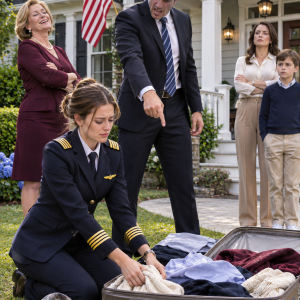
For once, I had no answer ready. His hand remained over mine, steady and warm, and I realized that the feeling between us had long since moved beyond professional respect. Neither of us spoke about it that night. The rules mattered, and so did the work. We understood that any personal relationship would have to wait until we could address the conflict of rank and responsibility properly.
We did not rush. We kept our boundaries clear, and the years passed with our connection held in conversations after long workdays, shared meals when duty allowed, and the quiet trust that comes from seeing someone under pressure and liking the person you find there.
The Name on the Invitation

When Owen was six, he was curious about everything. He loved dinosaurs, building sets with too many pieces, and asking questions while I was trying to cook dinner. He had my stubbornness and Graham’s deep brown eyes.
Caleb became a familiar presence in our home. At first, he would stop by to deliver work documents or discuss schedules. Then, somehow, he would be sitting on the living room rug with Owen, helping him build a plastic spacecraft or listening to an elaborate explanation of why a certain dinosaur would have made a better astronaut.
Owen began calling him “Mr. General,” a title Caleb accepted with a solemn nod and a smile he couldn’t quite hide.
One evening, while I was rinsing dishes, Owen looked up from the table.
“Does my dad know about me?”
I set the plate in the sink and dried my hands before answering. I wanted to tell him the truth without making him feel responsible for an adult’s absence.
“No, sweetheart. He doesn’t know you’re here.”
Owen considered that. “Would he want to know?”
I crouched beside him. “I can’t answer for him. But I can tell you that you are loved, and you’ve never been a burden to anyone who truly knows you.”
He nodded, then asked whether he could have another cookie. Children have a way of returning to the ordinary world faster than adults do. I was grateful for it.
A few days later, Caleb came to my office and closed the door behind him. He was holding a cream-colored envelope stamped with the White House seal.
“You’ve been selected for a presidential recognition,” he said. “The ceremony is next weekend.”
I stared at the envelope. My work on the regional logistics program and the evacuation during the deployment had been reviewed, but I hadn’t expected this.
“Sir, I don’t know what to say.”
“You can say you’ll attend.”
I opened the envelope and read the invitation. A separate sheet listed the civilian supporters and organizations connected to the event. I scanned down the page until one name stopped me.
Graham Keller, founder of Keller Aviation Systems.
The paper shifted in my hands. I read it again, hoping I had misunderstood. I had not.
Caleb’s expression changed when he saw mine.
“What is it?”
“Graham will be there.”
He knew the history. I had told him about the divorce, the pregnancy, and the years in which Graham had never asked about Owen. I watched Caleb reach for his phone.
“I can have the invitation reviewed.”
“No.” My voice came out more firmly than I expected. I placed the paper on his desk. “Let him attend. I’m bringing Owen.”
Caleb studied me, making sure this was a decision I had considered rather than a reaction to old hurt.
“Are you certain?”
“Yes. I’m tired of arranging my life around the possibility that Graham might be uncomfortable.”
He nodded once.
“Then we’ll make sure you and Owen have everything you need.”
In the days before the ceremony, I found a small navy suit for Owen. He stood on a chair while I straightened his tie, checking his reflection in the hotel mirror.
“Do I look important?” he asked.
I bent down and fixed the tie once more.
“You look like yourself, and that’s more important than anything.”
He grinned at his reflection.
I put on my dress uniform and fastened the final button. The ribbons on my chest represented years of work, hard choices, long separations, and a life I had built one steady step at a time. I caught my own gaze in the mirror and saw the woman I had become: still tender in places, still carrying the past, but no longer defined by the day someone left.
At the White House, Owen held my hand as we entered the grand hall. The reception desk was ahead of us. Then I heard Graham laugh.
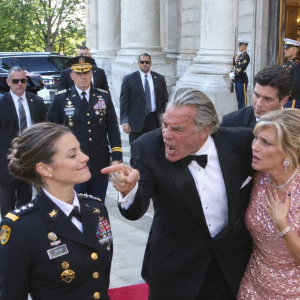
“You’re lost, Meredith,” he said. “You don’t belong here.”
I gave him no answer. I handed over my invitation, and the receptionist scanned it. Her expression changed as she read the screen. She looked toward General Rowan, who had just arrived.
“General, she’s here.”
That was when Graham’s smile began to fade.
The Moment He Understood
Caleb crossed the marble floor with the calm authority of someone who didn’t need to hurry to be noticed. Guests stepped aside as he approached. He was dressed in his formal uniform, his stars bright beneath the chandeliers.
Graham’s attention shifted from the invitation in his hand to the general coming toward us.
Caleb passed Graham without acknowledging his outstretched hand. He stopped in front of me and offered his own.
“Staff Sergeant Mercer,” he said warmly. “You look wonderful. The President is looking forward to meeting you.”
I took his hand. His expression held the same respect I had seen at the command center, only now it was visible to everyone around us.
Graham lowered his hand.
“General Rowan,” he said, trying to sound familiar. “Graham Keller. Keller Aviation Systems. We support several of the department’s programs.”
“I know who you are, Mr. Keller.” Caleb’s voice remained even. “I also know you and Staff Sergeant Mercer were once married.”
Graham’s eyes moved to me and back again.
“I didn’t realize she had connections at this level.”
Caleb’s expression tightened, but his voice stayed measured.
“Her invitation has nothing to do with personal connections. She is being recognized for her service. I expect you to speak to her with the respect her work deserves.”
A few guests nearby had turned to listen. Graham’s face flushed.
“Of course,” he said. “I meant no disrespect.”
“Then we understand each other.”
Caleb turned back to me.
“Shall we go in?”
Before I could answer, Graham looked down. Until then, he had seemed to register Owen only as the child holding my hand. Now he noticed the boy’s eyes and the shape of his face.
Owen looked up at him with quiet curiosity. Graham stared back, then looked at me. The years passed across his face as he began to count them.
“Meredith,” he said, his voice suddenly uncertain. “How old is he?”