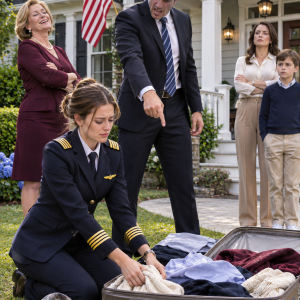
“Six.”
Graham’s shoulders went still. His mouth opened, but he couldn’t seem to find the next words.
“Is he…?”
I squeezed Owen’s hand.
“This is Owen,” I said. “He’s your son.”
Elise turned sharply toward Graham.
“Your son? You told me you didn’t have a child.”
Graham didn’t look at her. His attention remained fixed on Owen.
“I didn’t know,” he said. “Meredith, I swear I didn’t know.”
I thought of the night he’d asked for a divorce, of the words I had tried to say and the way he had looked at his watch. I remembered the test in my purse and the decision I made after he left.
“You didn’t ask,” I said. “That night, I was trying to tell you I was pregnant. You told me you had a meeting and that you were tired of my small life. I watched you walk out, and I decided Owen deserved to be wanted, not treated as a reason someone had to stay.”
Graham’s eyes filled with tears. He took a step toward us, then reached out as though he meant to touch Owen’s shoulder.
Caleb shifted between them, not threatening, simply making a clear boundary.
“Please give them room,” he said.
Graham stopped. Owen looked from Caleb to me.
“Mom, why is that man crying?”
I knelt so I could meet his eyes.
“He’s upset because he’s learning something important. You don’t need to worry about him, okay? You’re safe, and you’re with me.”
Owen leaned toward me, then glanced at Caleb. Caleb lowered his voice.
“And you have me, too, if you want me here.”
Owen nodded and rested his hand against Caleb’s sleeve.
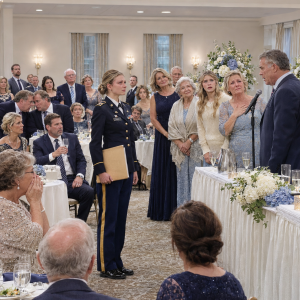
Graham watched that small exchange, and whatever he had hoped to find in the moment seemed to slip away. His wife had stepped farther from him. The guests who had once admired his confidence were now listening to him struggle to speak.
“I want to make this right,” he said. “I want to be part of his life.”
I stood, keeping one hand on Owen’s shoulder.
“If you want a relationship with him, we can discuss a careful plan with a family counselor and the proper legal guidance. It will be gradual, and it will be based on what is best for Owen. You don’t get to rush into his life because you’ve just discovered he exists.”
Graham nodded, unable to meet my eyes for long.
“I understand.”
“I hope you do.”
Elise touched his arm.
“We need to go.”
He turned toward her, but she was already walking toward the exit. Graham stayed where he was for a moment, alone in the middle of a room where he had expected to be celebrated.
I felt no triumph. I had imagined, years ago, that facing him again might bring a rush of anger or a sense of victory. Instead, I felt the calm that comes when an old wound is finally seen clearly: it had hurt, it had changed me, but it no longer decided what I could become.
Caleb offered his arm. I took it, and Owen walked between us as we headed toward the ceremony.
A Life Chosen in the Open

The recognition ceremony passed in a blur of introductions, applause, and careful smiles. The President pinned a medal to my uniform, and I tried to take in the moment without thinking of all the people who had helped me reach it. My mother was not in the room, but I felt her steady presence in every choice I had made since the day she carried Owen while I left for training.
Afterward, Owen fell asleep in a quiet suite upstairs. Caleb and I stepped onto a balcony overlooking the city. The air was cold, and the Washington Monument stood in the distance beneath the winter sky.
I rested my hands on the stone railing and let out a breath I hadn’t realized I was holding.
“He looked smaller than I remembered,” I said.
Caleb stood beside me, close enough that our shoulders touched.
“Sometimes people do when we stop carrying them around in our minds.”
I turned toward him.
“Thank you for today.”
“You didn’t need me to speak for you,” he said. “But I wanted him to understand that your place here was earned.”
That answer settled something in me. Caleb had not stepped in because I was helpless. He had stood beside me because he respected me, and because he understood that support could be offered without taking away someone’s strength.
He reached inside his jacket and brought out a small velvet box.
I stared at it.
“Caleb…”
He opened it. A simple ring caught the light, elegant and understated.
“I’ve spent a lot of years planning for things that might go wrong,” he said. “I couldn’t plan for how much I would care about you and Owen. I want to build a life with you, if you want that too. I want to be there for the ordinary mornings, the school projects, the hard conversations, and all the quiet days in between.”
He paused, looking at me with the same steadiness he had shown on the nights when work seemed to stretch forever.
“I love you, Meredith. Will you marry me?”
Tears blurred the lights of the city. They were not tears of grief or fear. They came from the strange relief of being offered a future without having to prove that I deserved it.
“Yes,” I said. “I will.”
He smiled, and I reached for him. His kiss was gentle, familiar in the way that comes from knowing someone over time, and hopeful in the way that comes from choosing each other clearly.
The months that followed were not perfect, because real life rarely arranges itself into neat endings. Graham asked to be involved in Owen’s life, and we established a careful process with professional guidance. His visits began slowly. He brought gifts at first, as if money could make up for years of absence, but Owen was more interested in showing him a drawing or explaining the rules of a game.
I didn’t tell Owen what to feel. I let him decide how close he wanted to be, and I stayed nearby. Graham had to learn that becoming a father was not something he could claim in a single conversation. It required patience, consistency, and a willingness to accept that Owen already had a full life.
Caleb and I married in a small ceremony the following year. Not long afterward, he legally adopted Owen. The day the paperwork was finalized, Owen ran across the yard and threw his arms around Caleb’s waist.
“Dad, look what I made!”
Caleb lifted him up, laughing as Owen held out a crooked model spaceship. I stood nearby and watched the two of them, feeling the quiet certainty of a home built through a thousand small acts of care.
For a long time, I thought the most important thing Graham had taken from me was the future I had expected. I was wrong. He had left behind a painful beginning, but I had made choices after that—one at a time—that became the foundation of a different future.
I did not need to see him suffer in order to know my life had become good. I did not need his regret to validate the years I had spent rebuilding. The greatest change was that his absence no longer felt like the center of my story.
I had once stood in a silent apartment, frightened about what would happen next. Years later, I stood beneath the bright chandeliers of the White House with my son’s hand in mine, surrounded by people who knew what I had earned and who loved us without conditions.
The past had brought me to that room, but it did not own the room. I did.